
Introduction
Nigeria desires to accelerate collective prosperity by investing in technical efficiency. This is captured in the 31-page document released on the country’s 63rd Independence Anniversary by Dr. Bosun Tijani, the minister of communications, innovation and digital economy. Titled: ‘Accelerating our collective prosperity through technical efficiency” (the draft ‘Strategic Blueprint’), the document is a strategic blueprint by the Minister of Communications, Innovation and Digital Economy (the ‘Ministry’). Dr. Bosun Tijani believes that this strategic plan is the “critical launchpad” Nigeria needs to thrive in the digital age.
This is the first of a series of thoughts I’ll be sharing about the Strategic Blueprint in the coming weeks. Today, I’ll focus on three areas as follows: (1) Imbibing a culture of openness and accountability; (2) Adopting a solid implementation plan for an efficient and effective strategic blueprint; and (3) bridging the (seeming) gap between the draft Strategic Blueprint and the National Digital Economy Policy and Strategy (NDEPS) by the same Ministry. I believe these three areas are fundamental as Nigeria looks to engage all stakeholders in the public and private sectors to reposition the country in the global digital economy.
The need to imbibe a culture of openness and accountability.
Firstly, it’s refreshing to know that the minister intends to imbibe a culture of openness and accountability in order to drive support for the ministry’s policies and projects. Opacity and lack of accountability are prevalent in the public sector. Most ministries, departments, and agencies (MDAs) do not operate transparently. The process of policymaking and implementation hardly involves the level of wide consultations and stakeholder engagements that sound policies need to work.
This is why I have always emphasized that it is vital for public agencies and institutions to democratize and decentralize their approach to policymaking and implementation. This will help maximize the opportunity of getting the full buy-in of relevant stakeholders and the members of the public, including the targeted beneficiaries of these policies. Governance is people business, not government business so to speak. The only business of government is the people, not itself. Besides, equity is key.
I am delighted to know that the new minister, Dr. Bosun Tijani, intends to adopt a culture of openness and accountability. As stated in the draft strategic blueprint, “Our objective with this document is not just to inform, but to reimagine and reintroduce a new way of doing things with efforts to drive equity through a culture of openness and accountability.” Hopefully, the minister successfully delivers on this. If the enthusiastic engagements the minister is already getting on social media is anything to go by, it appears the minister has hit the ground running. Stakeholders and the members of the public—ever eager to contribute to and accelerate our collective prosperity—naturally welcome openness and accountability.
Nigeria needs a solid implementation plan to execute each pillar in the strategic blueprint.
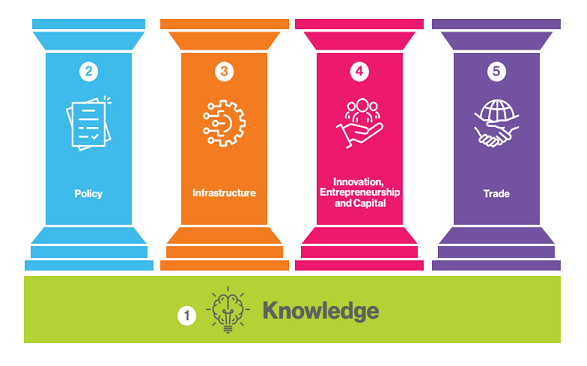
Second, I find the 5 pillars upon which the acceleration of our collective prosperity would be built a well thought out structure. Each one reinforces the other. One can hardly speak of achieving technical efficiency in anything without first investing in knowledge. And knowledge without policy that stimulates, incentivizes, and directs it for the attainment of self-empowerment and national development is hardly valuable. In the same vein, without infrastructure, knowledge will most likely end up being utilized by nations who have invested in the infrastructure that a knowledge economy needs to thrive. Yet, infrastructure without innovation, entrepreneurship & capital, may result in stunted growth. With trade, Nigeria’s pool of local and diaspora tech talent is opened to a window of global opportunities. We must solidly build these 5 pillars. This will require an efficient and effective implementation plan.
In the implementation plan expected to be released by the Ministry, roles and responsibilities should be clearly and specifically defined. Deliverables should come with timelines. A trackable accountability system should also be considered. Over the years, we have had too many policy documents, including implementation plans, that leave too much room for failure. If Dr. Bosun Tijani really means business, this needs to change.
The present (seeming) gap between the strategic blueprint and the National Digital Economy Policy and Strategy (NDEPS) needs to be bridged.
Third, noticeably, there is an alignment gap between the Ministry’s draft strategic blueprint being introduced by the Ministry under Dr. Bosun Tijani and the National Digital Economy Policy and Strategy (NDEPS) introduced by the former Minister, Prof Isa Ali Ibrahim Pantami.
I understand that the new minister must align the Ministry’s policy with the political agenda of the new administration. This is important. Policy without political will is play. But it is also important that Nigeria demonstrates its readiness to embrace policy continuity—except pre-existing policies have been found and proven to be defective, inadequate, unhealthy, or no longer relevant. We must be intentional about bridging this gap—real or perceived—in the finalized strategic blueprint.
The NDEPS, unveiled by the former President Muhammadu Buhari, is a vital policy document by the Ministry. It was presented to over 2,500 attendees at the International Conference Centre, Abuja FCT during the International e-Nigeria Conference, 28 November 2019. This was after receiving inputs from over 300 stakeholders. NDEPS also integrated findings from the World Bank Diagnostic Report on Nigeria.
Notably, unlike the draft Strategic Blueprint that is largely limited to the 4-year dispensation of the current administration, NDEPS is a 10-year plan, from 2020 to 2030). It may continue to serve as a foundational policy document. Besides, a study of the NDEPS document will reveal that the 5 pillars of the Strategic Roadmap document are essentially encapsulated in the 8 pillars of the NDEPS. Specifically, I will identify them respectively: Developmental Regulation (Policy), Digital Literacy and Skills (Knowledge), Solid Infrastructure, Service Infrastructure, Soft Infrastructure (Infrastructure), Digital Services Development and Promotion, Digital Society and Emerging Technologies (Innovation, Entrepreneurship & Capital), and Indigenous Content Development and Adoption (policy, and to some extent, trade).
Continuity, except where a policy strategy is manifestly and provenly bad, provides policymakers, regulators, and other stakeholders a better opportunity to build on and deepen the work already done.
This is one of the major reasons why I strongly believe that Nigeria truly and urgently needs a Digital Economy Act. A Digital Economy Act will provide the much-needed legislative framework for Nigeria to walk the talk, regardless of who is in Aso Rock. Nigeria needs a healthy culture and solid framework for continuity in policy business. This is more so in the globally competitive digital economy. Here, every serious nation wants a bite of the chocolate. So Nigeria cannot afford to weaken its chance there. We should not allow—deliberately or otherwise—the ever-changing weather of Nigerian politics to disrupt what should be a stable policy climate that innovators and investors can trust.
Just as chapter 7 of the minister’s strategic blueprint captures how it aligns with the Renewed Hope Agenda of the current administration, the NDEPS should also be similarly captured in the finalized strategic blueprint. Also, while speaking to the various aspects of the 5 pillars, reference could be made to the relevant provisions of the NDEPS. This will demonstrate policy consistency. For example, under the National Broadband Plan in the opening paragraph of page 13 of the draft strategic blueprint, mention is made of driving Nigeria’s digital transformation “in line with the National Digital Economy Policy and Strategy (NDEPS).” This is the only reference made to the NDEPS in the draft strategic blueprint. Meanwhile, across the 5 pillars of the strategic blueprint, I see a number of areas consistent with the NDEPS. By specifying these areas in reference to the NDEPS, I think Nigeria will demonstrate her commitment to implementing long-term policy frameworks. Polity before politics. All stakeholders, including innovators and investors, will greatly benefit from this approach.
Conclusion
Nigeria’s draft Strategic Blueprint for accelerating the collective prosperity of Nigerians through investment in technical efficiency is a welcome development.
Over the years, the Ministry has demonstrated keen interest in leveraging technology to drive the development and growth of the digital economy by investing resources—however limited by our lean public purse. The 5 pillars of Knowledge, Policy, Infrastructure, Innovation, Entrepreneurship & Capital, and Trade—as presented in the draft Strategic Blueprint on which the country’s digital economy will be built—are however not entirely new. What seems to be new is the renewed hope that the new political administration has promised to deliver across various sectors of the economy, including the ICT sector. Also, Dr. Bosun Tijani, straight from the private sector to the public sector, is also refreshingly new.
As Nigeria embarks on yet another journey to transform her economy through the Ministry, it is critical that we get it right. We must (1) truly embrace the culture of openness and accountability, (2) fully execute an efficient and effective implementation plan that delivers the goods and hold relevant bodies accountable, and (3) duly integrate the Strategic Blueprint with the pre-existing 10-year plans contained in NDEPS. This is key.
1 Comment
Leave A Comment
Copyright © 2025 Senator Ihenyen. All rights reserved. Designed by Beacon Lanbs & Tech Solutions
15/10/2023
Thanks Senator for this article, the ministry have all the resources needed to execute the full plan as they have made. Let’s go from planning to execution.