
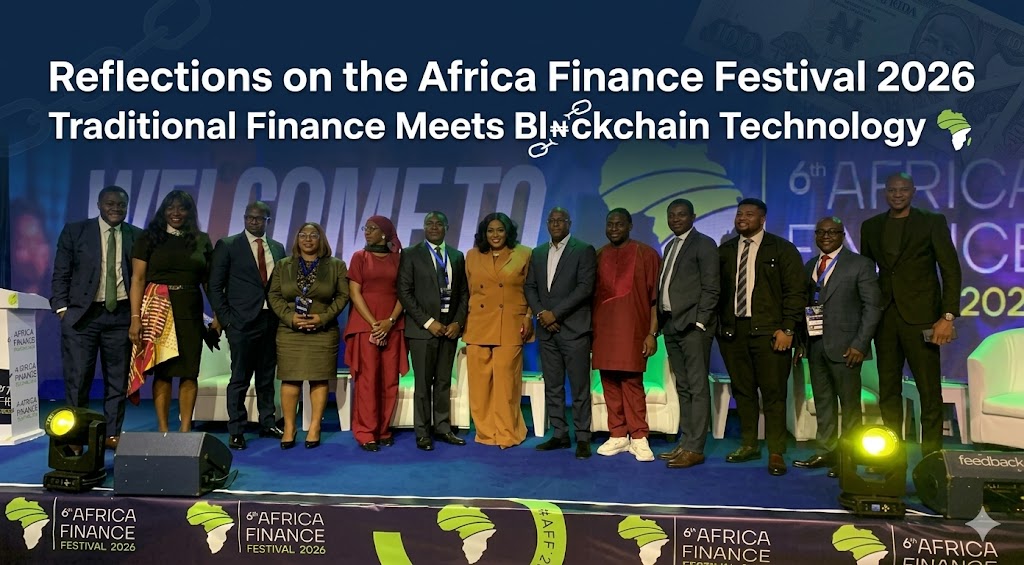
The energy in Lagos at the just-concluded Africa Finance Festival 2026 (AFF 2026) was simply contagious. Held 12–13 May 2026 at Lagos Oriental, participants included asset managers, bankers, innovators, investors, regulators, governments, and fellow professionals. The conference theme was “Future Forward: Building Resilient, Sustainable & Digital Financial Systems for Africa.”
Clearly, we are no longer just debating the possibility of the emergence of Africa finance and its global competitiveness in today’s digital economy—we are actively looking forward, architecting its foundation.
Narrowing down to one of the emerging sectors, the blockchain technology-powered virtual asset sector, I had the honor of participating in the panel session, “Enabling Innovation Without Killing It.” This theme resonates deeply with my work as a legal professional, policy consultant, and regulatory architect.
I greatly thank the panel—Buki Ogunsakin (Principal, BBO Solicitors & BoT Member, VASPA), Nathaniel Luz (President, Africa Stablecoin Network), and God’spower Effiong (Founder, AGTM), and a special shout-out to our brilliant moderator, Favour Uche (Star Associate at Infusion Lawyers and Assistant Lead, Policy & Regulatory Affairs at VASPA), for a brilliant session.
I find the conversation a timely reminder that regulation is—or should be—the operating system of innovation. Imagine a situation where the OS is buggy? The applications—our startups and financial services—will inevitably crash.
The True Cost of Regulatory Friction
During the panel session, I briefly highlighted what I consider the cost of poor regulation in “real time.” This is because if we do not acknowledge the primary costs of poor or regulation, we will logically struggle to make significant progress in good time:
- Banking Toll: For bankers, it meant banking rails were used for the liquidity, but couldn’t monetize the services. This means that banks and other financial institutions bore the AML/KYC risk of these “crypto” transactions, this compliance burden came with no reward by way of fee incomes from regulated VASP partnerships. I’m happy to note that with regulations now gradually replacing bans across Africa, the narrative is changing, enabling strategic collaboration and smarter compliance.
- Brain Drain: When local frameworks are too rigid or the business environment is too uncertain, our brightest founders move their headquarters to digital hubs like Dubai. When they leave, they take intellectual property and potential tax revenue with them. This is both brain drain and rain drain. As the Head of Innovations and Emerging Technologies Practice at Infusion Lawyers where I work with both local and global players in the space, I see this unhealthy pattern. And it is something we must change. We have to make it rain in Africa, and ensure that our best brains build with us, for us, and for the world.
- Capital Flight: Bankers and asset managers in the room definitely know better than anyone that capital doesn’t wait for permission—it finds a path. This is simply because investors will go where clarity and certainty is. Ambiguity drives capital to jurisdictions that offer a clear roadmap, resulting in avoidable regulatory arbitrage—much to the disadvantage of jurisdictions that lack adequate regulation.
- Institutional Gaps: When regulation is lacking, institutional investors and asset managers are left on the sidelines, losing out on the fees and Assets Under Management (AUM) that a regulated sector would provide. This is where the market-development function of the regulator comes in, ensuring a profitable balance between innovation and regulation. Such approach boosts confidence in the market and trust in the system, encouraging institutional investors to drive capital and other resources into that market. This is how the window of opportunities opens widely, creating jobs and expanding the economy without necessarily compromising the safety and soundness of the financial system.
Three Pillars for Market Growth
I have always believed in Development Regulation. I still do, especially for developing countries and emerging markets, like Nigeria for instance.
To move from a culture of mere policing to a culture of Developmental Regulation, I recommended three structural pillars that separate frameworks that grow markets from those that effectively end up strangling them, no matter well-intentioned those frameworks are:
- Risk-Based Classification: Regulating based on an asset’s economic function rather than its underlying technology. I have been emphasizing this for years. But as simple as it looks, it is often easier said than done. The devil, they say, is in the details. Though most regulators acknowledge the need for risk-based regulation, one way or another we still see many jurisdictions end up with largely a one-size-fits-all approach or blanket treatment of virtual asset innovations. This stifles the sector, in most parts.
- Proportionality (Tiered Licensing): Creating entry-level licenses for VASPs in the lower tier and scaling capital requirements to VASPs in the higher tiers, ensuring that misaligned capital requirements don’t act as an accidental barrier to entry. I believe this reasoning is not only valid but sound. Risk profiles often differ. In the age of RegTech, data should help improve supervision, not isolate innovations without evidence-based regulation.
- Co-Creation: A key distinction between regulation and administration is the central idea of collaborative thinking with the market or sector you want to regulate. With strategic and periodical stakeholder engagements, policy review collaborations, and utilizing sandboxes and safe harbors to allow for experimentation under supervision, countries can co-create more globally competitive, safe, and sound business and regulatory climates for innovation to thrive without losing trust and confidence in the system.
The Convergence: Where TradFi Meets Blockchain
One of the most compelling observations from this year’s festival is the undeniable convergence between traditional finance (TradFi) and the virtual asset sector. We are witnessing a historic meet-in-the-middle. Personally, it was a pleasure also getting to meet players from both the TradFi and “DeFi” sectors.
From the First Bank Group exploring institutional custody to MTN integrating digital payment rails, and FinTech giants like Flutterwave, Paystack, and Paga leveraging blockchain for cross-border efficiency—the walls are coming down. This is not just a trend; it is a structural shift toward a unified digital economy. Blockchain is no longer considered the “rebellious outsider”; it is becoming the “competitive edge” or “innovative leverage”—delivering value silently in the backend—of modern African finance.
No noise. No speculations. Just value.
This is why I strongly believe that what we need to unlock potentials in the industry is alignment. Where practitioners are able to find common ground and provide the government with a roadmap for digital asset formalization, designing a sovereign blueprint is achievable. After all, the best regulations are co-built.
The Case for a Unified Virtual Assets Act
While we acknowledge the growing maturity shown by governments and regulators across Ghana, Kenya, Nigeria, and South Africa particularly in the formalization of the virtual asset sector in Africa, there is still significant work to be done. Nigeria, my own country, has made notable strides with the Investments and Securities Act (ISA) 2025, but the need for an overarching, unified Virtual Asset Law is still apparent.
Currently, identifiable frictions and alignment gaps between various agencies have led to some level of regulatory arbitrage. A single, comprehensive Act would help harmonize these efforts, eliminate confusion for operators, and help Nigeria improve the level of trust and confidence in its digital asset space.
While the much-needed legislation is in sight, I am proud of the recent launch of the practitioner-led, industry-wide project, Project Green-White-Green in Nigeria. Led by the Virtual Asset Service Providers Association (VASPA), this project is essentially about the need for the constructive realignment of Nigeria’s virtual asset sector, leveraging the idea of co-creation by all relevant stakeholders.
A Call to Intentionality
To the virtual asset service providers (VASPs) and stakeholders reading this: Now is the time to get involved.
As the virtual asset sector converges with the wider financial services landscape and digital economy, we cannot afford to be passive observers of policy. We must be intentional about advocating for innovation-friendly regulations that protect consumers while rewarding builders.
Appreciations and Awards!
I feel most honored to have been awarded the Blockchain Personality of the Year (Blockchain Policy Award) at the Award & Dinner Night. And congratulations to all fellow awardees! Special recognitions such as this remind me that while the road is long, we are moving in the right direction.
My profound thanks go to Akin Naphtal, Founder & CEO of InstinctWave Group for his leadership, his entire team, including the amiable Victor Solomon, for their and other individuals and brands who made the Africa Finance Festival 2026 a successful one.
I look forward to the 2027 edition.
With the level of conversations out there and the synergies being built today, I am confident that Africa will not just keep up with the global digital economy—we will lead it. We will get there. And we will thrive.

2 Comments
Leave A Comment
Copyright © 2025 Senator Ihenyen. All rights reserved. Designed by Beacon Lanbs & Tech Solutions
14/05/2026
[…] the Africa Bitcoin Conference, MoonShot by Techcabal, Techpoint Conference, Technext Conference, the recent Africa Finance Festival, and a number of other platforms, when regulation is well designed and deployed, it is a catalyst […]
14/05/2026
[…] make three major things happen across Africa. For this purpose, I will simply reproduce below the recommendations I made at this year’s Africa Finance […]