
Africa’s Virtual Asset Sector: The Long Wait to Win and Arsenal’s Triumph
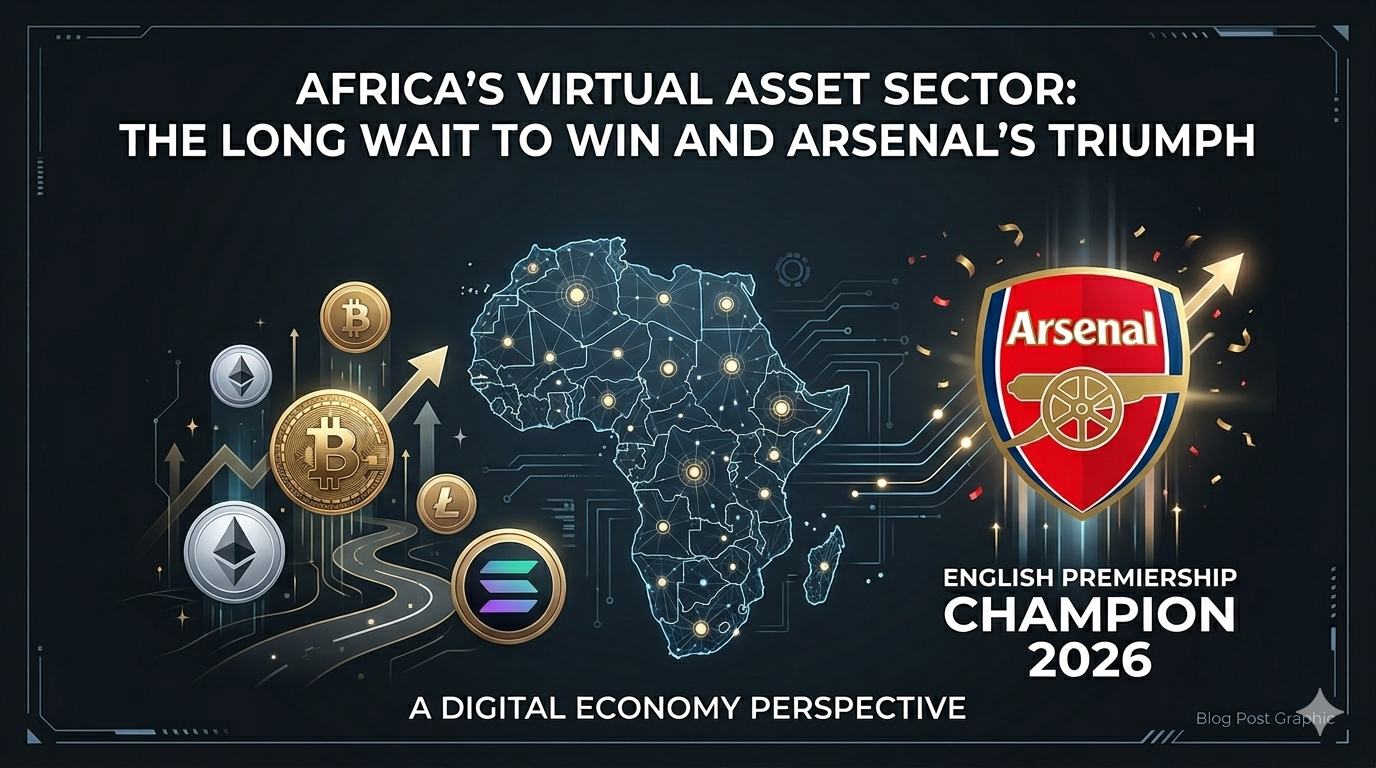
Football has a rhythm. Though a Chelsea fan whose English club has struggled all season to find rhythm, I see some rhythm when I watch my rival club, Arsenal, play. When Arsenal lack rhythm, they try to find a formula to either get all 3 points or share the spoils. And when they drop points, they just focus on the next game. I see a team that has spent years refining its identity.
Moving from raw potential to another level, Arsenal is one force that, I must admit, demands respect in club football today. The “Gunners” have greatly progressed. But that progress didn’t happen by accident; it was the result of intentionality and consistency. You raise your head up to see the big picture on the horizon, and then put your head down to do the work. The blood in battle; the sweat in victory; the tears in defeat—the dots begin to connect. And suddenly, the “bottled” days are behind you. All you can see now are Champions.
Should Arsenal also win the Champions League in Budapest next week, the Gunners would have bought their rights to become the newest “noisy neighbors” in North London! And should Arsenal lose the Champions League, it doesn’t invalidate the football club’s success this season.
Africa’s Long Wait for Regulations that Enable Innovation to Compete Fairly and Have a “Winning” Chance
Away from the now red-sky London to Lagos, inspired by the beautiful game of football and the digital frontier we inhabit, today I write about why Africa’s long wait for the “premiership cup” in digital finance regulation—where frameworks truly enable a thriving, trusted virtual asset sector—must end.
There is no reason why it can’t, or shouldn’t.
From Lagos to Accra, Nairobi to Johannesburg, Port Louis to Rabat, we have the players (operators), the fans (the users), and the sheer market scale. Add to that the passion and the use cases that continue to drive the market regardless of long-standing misaligned regulation—and sometimes, zero regulation. Yet, we are still standing in the tunnel, waiting for the whistle to blow.
Our African virtual asset sector is standing in that same tunnel, waiting for the umpires to make the rules and the referee to blow the whistle. Largely, we are waiting for the “triumph”—that moment when regulation stops being a hurdle and starts being the engine that drives us forward. And when I speak of moving ‘forward,’ I am not merely advocating for the formalization of the virtual asset sector.
Far too often, formalization, when not optimized for enablement, largely leaves an entire industry languishing in the “tunnel.” In that tunnel, you find “untiered” paid-up capital and licensing fees, transaction-level levies, enforcement-based policing over co-building policymaking approaches, fiscal-focused frameworks without business-enabling support or incentives. You find barriers to entry—and unduly and unnecessarily so more often than not. Good intentions gone bad. So, at best, while players may be eventually cleared to play, they end up finding themselves struggling to play competitively—especially relative to opposing teams from other climes: competitors. In other words, compliance without enablement is not competition; it is simply keeping the game from being played. Throughout my nearly 15 years in legal practice and compliance, I have come to view compliance not as an end in itself, but as a secondary framework built entirely in response to innovation.
So, rather than merely checking boxes without really enabling innovation, Africa must think out of the box, becoming the “boxes” that other parts of the world also check against. No “wait-and-see” and no “copy and paste;” just a co-built, well-oiled economic engine in a new digital finance frontier. Our players must stop being made to either play the “beautiful game” on a bad pitch or keep waiting to play on a pitch that is always “under construction.” Regulation is today’s biggest tool for national economy competitiveness.
The Landscape: A Tale of Four Markets
For a long time, the narrative globally was about whether virtual assets or crypto should even exist in our markets. In Africa, at a time we should probably be the continent that has the best understanding of the paradigm shift that emerging technologies will catalyze across sectors the most, the time took even longer. At a time African governments, policymakers, and regulators should understand the most that emerging technologies offer more competitive advantage to continents like Africa that have serious “leapfrogging” to do, the time took even longer. Rather than lead the pack in policymaking as new economies become birthed on the wave of emerging technologies, we were waiting, again, for the West to show the way.
Finally, today, the question has shifted from “if” to “how,” though the execution varies drastically across the continent—and not without “collateral damages”.
- Nigeria: We’ve seen a monumental and positive shift. With the enactment of the Investments and Securities Act (ISA) 2025, digital assets are formally integrated into the capital markets framework. The era of the banking ban is over, allowing financial institutions to work with licensed Virtual Asset Service Providers (VASPs). The challenge now is moving beyond the initial ISA legislation victory to ensure consistent implementation that doesn’t stifle the very innovation we want to protect. When you look at the Nigeria virtual asset sector today, it is largely stuck between formalization and acceleration. This does not mean that Nigerian regulators, particularly the SEC, have not been at work. Two provisional licences to Busha and Quidax under the SEC’s Accelerated Regulatory Incubation Program (ARIP) since 2024 is not good enough. According to official reports, I’m aware that others, specifically Blockvault Custodian, Wrapped CBDC Ltd (the cNGN naira-pegged stablecoin project), Trovotech Ltd, VineKross Technologies Ltd (Hashgreed), and NASD OTC Securities Exchange, were simultaneously admitted into SEC’s Regulatory Incubation (RI) Program to test specific digital finance products. At the time of writing, no official update from the SEC regarding the status of these platforms and the application status of other applicants. In fact, last year I suggested that the SEC should seriously consider publishing a public report on its ARIP and RI programs. The “stuck-in-the-tunnel” situation above reflects the urgent need for what VASPA describes as the “constructive realignment” of Nigeria’s virtual asset sector. Essentially, we must transition from an era of regulatory intentions and bureaucratic paperwork and activity to one of clear, demonstrable, and measurable action. As we aptly put it in Nigeria, it is time for Nigeria to ‘show workings’. With my community of advocates, I am ready to collaborate with the CBN, NRS, SEC, NFIU, and the NSA to ensure that Nigeria does exactly that: ‘show workings’.
- South Africa: The Southern Africa giant is the tactical master of this game. By classifying crypto assets as financial products under the FSCA, South Africa provided a solid baseline for legal certainty at a time when other African countries were either still busy banning or drafting “perfect” frameworks. As of 31 March 2026, the FSCA has officially approved and issued 310 full crypto asset service provider (CASP) licenses. This is out of the 533 total applications received. According to the FSCA, it declined 17 applications for failing to meet “fit and proper” guidelines or operational competency metrics, while another 124 were voluntarily withdrawn following regulatory discussions, leaving the remaining 82 applications still under active review. This is what regulatory accountability and transparency look like. However, South Africa is also currently at a crossroad: In its recently proposed draft regulations, including aggressive search-and-seize powers, the country has introduced turbulence. If not properly managed, this risks treating the virtual asset sector more as a threat rather than an economic driver with new risks. Let’s hope South Africa evolves.
- Kenya: Kenya recently cemented its framework with the passage of the Virtual Asset Service Providers Bill in late 2025. It employs a dual-regulatory model, splitting oversight between the Central Bank and the Capital Markets Authority. While it’s highly structured, the requirement for local physical offices and strict compliance obligations means startups need robust teams just to navigate the reporting lines. Understandably, many operators have raised serious alarm over what they consider prohibitive prudential requirements, including minimum paid up capitals that dwarf the highest paid-up capital requirements you will find in Asia, Europe, the Middle East, and North America. Where is Kenya flying to?, one begins to wonder. Clearly, these are the common policy-innovation gaps we often witness in Africa, requiring philosophical shifts and structural realignments.
- Ghana: Like its peers, Ghana is actively carving out its space. The goal is to move from informal utility to regulated maturity, understanding that clear, predictable rules are the only way to attract the institutional Foreign Direct Investment (FDI) that moves a nation’s GDP. Personally, I am rooting for Ghana to get its regulatory frameworks right. This will allow advocates like me to cite African examples of how to effectively regulate an emerging digital finance sector—one that potentially touches the lives of over a billion people. The implications span from digital and financial inclusion to economic freedom and the fundamental tenets of the rule of law. Africa must fully grasp this paradigm. This is not merely a ‘crypto’ issue, nor is it strictly about tax revenue or market-entry licensing. Rather, it is a reflection of the multi-dimensional life and comprehensive rights of the African citizen in today’s digital economy.
The ultimate purpose of regulation is to enable a thriving market that is profitable for the operator, safe for the user, and secure for the investor—not to stifle it. Any regulation that fails to achieve this balance is merely bureaucracy taking a catwalk; a Yokozuna on high hills.
This is why I am solidly behind the practitioner-grade, industry-wide, VASPA-led initiative, Project Green-White-Green in Nigeria. Thankfully, I understand that Nigeria is only the beginning—with Ghana, Kenya, and South Africa on the radar as well. If you would like to have one tailored to your African country, kindly reach out so we can work together, under a Pan-African mission, to “bridge” the long wait for the continent’s virtual sector to get this right.
Why the Long Wait Must End
We talk about the long wait for Africa to thrive, but the delay isn’t due to a lack of interest. As highlighted above, it’s largely due to a lack of contextual regulation.
Too often, we look for off-the-shelf solutions from abroad. But the African socio-economic context—characterized by a young, tech-savvy population and a real need for efficient, low-cost, boundless digital finance solutions—is unique. When regulation is heavy-handed or disconnected from the reality of the average user, it doesn’t stop innovation; it just drives it underground. That “underground” has led to the eruption of earthquakes in the financial system that we cannot continue to live with.
Investors don’t fear regulation. What they fear is ambiguity. We need overarching, unified virtual asset laws across Africa—including my country Nigeria—to bridge the much-too-apparent alignment gaps amongst various agencies.
The real victory—our own “Arsenal triumph”—will come when we stop regulating for the sake of control and start “co-building” with the industry. We need frameworks that can make three major things happen across Africa. For this purpose, I will simply reproduce below the recommendations I made at this year’s Africa Finance Festival:
- Risk-Based Classification: Regulating based on an asset’s economic function rather than its underlying technology. I have been emphasizing this for years. But as simple as it looks, it is often easier said than done. The devil, they say, is in the details. Though most regulators acknowledge the need for risk-based regulation, one way or another we still see many jurisdictions end up with largely a one-size-fits-all approach or blanket treatment of virtual asset innovations. This stifles the sector, in most parts.
- Proportionality (Tiered Licensing): Creating entry-level licenses for VASPs in the lower tier and scaling capital requirements to VASPs in the higher tiers, ensuring that misaligned capital requirements don’t act as an accidental barrier to entry. I believe this reasoning is not only valid but sound. Risk profiles often differ. In the age of RegTech, data should help improve supervision, not isolate innovations without evidence-based regulation.
- Co-Creation: A key distinction between regulation and administration is the central idea of collaborative thinking with the market or sector you want to regulate. With strategic and periodical stakeholder engagements, policy review collaborations, and utilizing sandboxes and safe harbors to allow for experimentation under supervision, countries can co-create more globally competitive, safe, and sound business and regulatory climates for innovation to thrive without losing trust and confidence in the system.
By the way, I’ve seen places where, similar to the 2021 crypto ban by Nigeria’s Central Bank, there appears to be a ban or prohibition of peer-to-peer (P2P) transactions, onramp and offramp. But like the Nile River in the north and the River Niger in the west, P2P transactions continue to flow. Apparently, rather than regulate the actual and perceived risks associated with P2P, we are effectively repeating history by choosing to simply ban, and hope the problem goes away.
But it never has, and never will. You will only end up driving P2P underground, all over again.
Today, P2P has become a part of the new digital finance economy. So, rather than ban it completely, should we not formalize P2P merchants as a specialized class of agents? This will help Africa turn P2P into a regulated engine for inclusion, safer for all—not isolated, only to end up ravaging our financial system with viruses that are outside our control. We have been here before. Haven’t we?
The Bottom Line: The Convergence of TradFi and Blockchain
The most compelling observation in 2026 is the growing convergence between traditional finance (TradFi) and the virtual asset sector. From banks exploring institutional custody to telecom giants integrating digital payment rails, the walls are coming down.
Africa is not a spectator in the global digital asset economy; we are the main event. The market is growing, the demand is clear, and the talent is home-grown.
If our regulators can fix the “rules of the game” to suit our specific, vibrant reality, the long wait will be over.
Think about it. We aren’t asking for a free pass. We are asking for a fair pitch. It’s time Africa allows itself to play the “beautiful game”, compete globally, and finally win.
Recent Posts
Copyright © 2025 Senator Ihenyen. All rights reserved. Designed by Beacon Lanbs & Tech Solutions