
Why President Trump’s New Fintech Order in the United States Matters for Africa
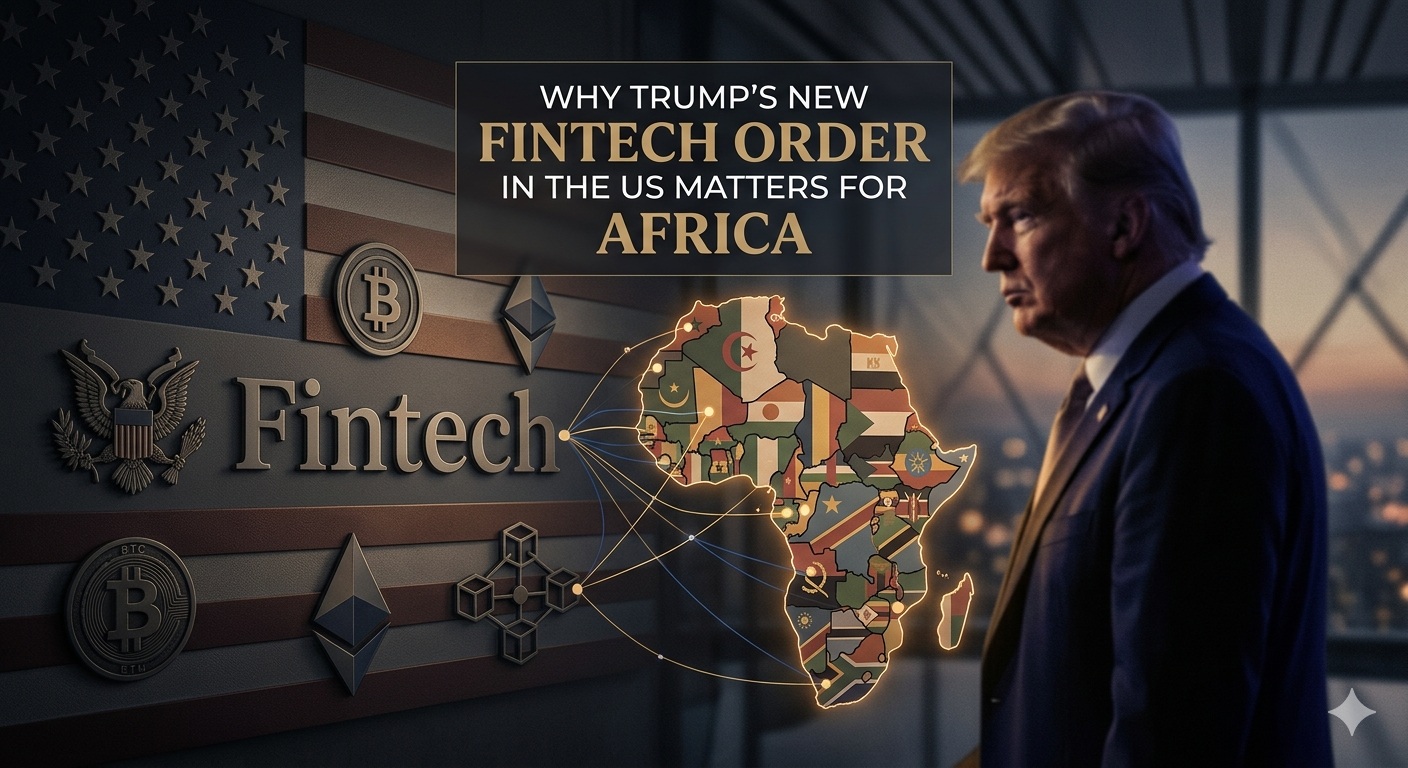
The global financial landscape just took a significant step toward co-building. On 19 May 2026—the day Arsenal Football Club finally won the English Premier League after a 22-year wait—President Donald Trump was gunning for a different kind of cup: a U.S. where walls between FinTech and traditional financial services will no longer exist.
His arsenal?
An executive order to achieve realignment.
President Trump signed an Executive Order titled “Integrating Financial Technology Innovation into Regulatory Frameworks”. This signals a massive pivot in U.S. policy. And this matters for Africa.
For those of us in the African regulatory climate—advocating for “Developmental Regulation” and the formalization of digital assets—this order isn’t just an American event; it is a global benchmark. I think it provides a direction on how to bridge the gap between legacy banking and the digital future.
The Core Mandate: From Policing to Integration
At its heart, this Order is a direct challenge to the “incumbent-first” model. It instructs U.S. Federal financial regulators to conduct a top-down review of existing rules to remove “overly burdensome and fragmented regulations” that have historically served as barriers for fintechs.
What makes this particularly striking for us in Africa is the directive to the Federal Reserve to evaluate access to payment accounts and services for non-bank financial companies. It acknowledges a fundamental reality: when you block innovators or new entrants from equal participation in the financial system, you haven’t just stopped innovation; you have created a more fragmented and an avoidable room for unmonitored risks in the system.
The U.S. President, Donald Trump, sure knows how to play his trump card.
Why this Resonates with My Africa Advocacy
As I have consistently pointed out over the years at forums like the Africa Bitcoin Conference, MoonShot by Techcabal, Techpoint Conference, Technext Conference, the recent Africa Finance Festival, and a number of other platforms, when regulation is well designed and deployed, it is a catalyst for industry growth and national development.
When thoughtfully co-built, designed and deployed, regulation acts as a catalyst for industry growth and national development.
Conversely, ill-conceived policy stifles progress, leaving an industry stagnant at best—and, at worst, regressive. Such failure transforms a potential economic engine into a systemic liability, posing risks not only to the industry itself but to the broader business and regulatory climate.”
In other words, poor regulation turns a potential asset into an actual liability—otherwise manageable risks become systemic viruses. No one wants to have anything to do with that!
Three Major Strategic Moves We Have Been Pushing For
This U.S. Executive Order validates three specific strategies many advocates, including me, have been pushing for across Nigeria and the broader continent:
- The Co-Building Philosophy: By mandating that regulators identify how to facilitate partnerships between FinTechs and regulated institutions, the Executive Order moves the needle from oversight to integration. This is the exact philosophy behind initiatives like the practitioner-grade, VASPA-led Project Green-White-Green—we aren’t just asking to be regulated; we are asking for a framework that acknowledges our role in the modern financial architecture.
- Breaking the Barrier to Entry Logic: The U.S. is now explicitly acknowledging that traditional regulations are often “relics of a time when financial services were predominately provided in brick-and-mortar-centric settings.” We face this daily in Nigeria and Africa generally where legacy frameworks often effectively penalize digital-first players.
- Modernizing Payment Rails: The focus on “real-time instant payment networks” mirrors the work our local FinTechs across Africa are doing. If the U.S. is now moving to formalize non-bank access to central payment systems, it puts immense pressure on our own regulators to ensure our domestic policies don’t fall behind global best practices and don’t struggle to enable players in Africa to compete with their US and global counterparts.
We must, as stakeholders, walk the talk of constructively realigning the industry—in the short term, mid-term, and long term.
A Lesson in Regulatory Maturity
For me, the most compelling takeaway for African stakeholders is the Executive Order’s insistence on balance.
It does not call for a “Wild Wild West” approach but for a review that balances innovation with “safety and soundness, consumer and investor protection, market integrity, and financial stability.”
This is the holy grail of my work and those of my fellow advocates. We aren’t asking for less regulation; we are asking for better regulation. We are asking for an opportunity to compete.
What This Means for African Stakeholders
We are entering a season of Great Convergence. As the U.S. moves to integrate FinTechs, including digital assets innovation, into the heart of its financial system, the standards for custody, settlements, risk management, and compliance will rise.
For Nigerian and African FinTechs, this is a clarion call. We must be intentional about governance. As these frameworks become more formal globally, our internal controls must be ironclad. And this is where collaboration and advocacy matter:
- Collaboration: The “Us-versus-Them” mentality between TradFi (banks) and digital innovators is dying—and fast. The future belongs to those who collaborate.
- Advocacy: We must continue to push for an overarching, unified virtual asset law in Nigeria, just as Kenya and Ghana have both done recently. We cannot afford to have fragmented policies and regulations while the rest of the world, including the U.S. is realigning and streamlining theirs.
The Path Forward
I am encouraged by this development from North America. It signals that the innovation-friendly approach we have been championing in Accra, Lagos, Nairobi, Johannesburg, and Tunis and beyond is aligned with the global trajectory.
Africa has the opportunity to leapfrog these stages if we act with intent. Let us use this momentum to continue our work with regulators across the continent—from the CBN to the SEC; the CMA to the CBK; the SARB to the FSCA—to ensure that we aren’t just watching the future of finance happen but actively building it.
The shift toward an institutional digital economy is well and truly underway.
What are your thoughts on this new U.S. policy? Do you believe it will accelerate the adoption of digital assets by traditional African financial institutions?
Recent Posts
Copyright © 2025 Senator Ihenyen. All rights reserved. Designed by Beacon Lanbs & Tech Solutions