
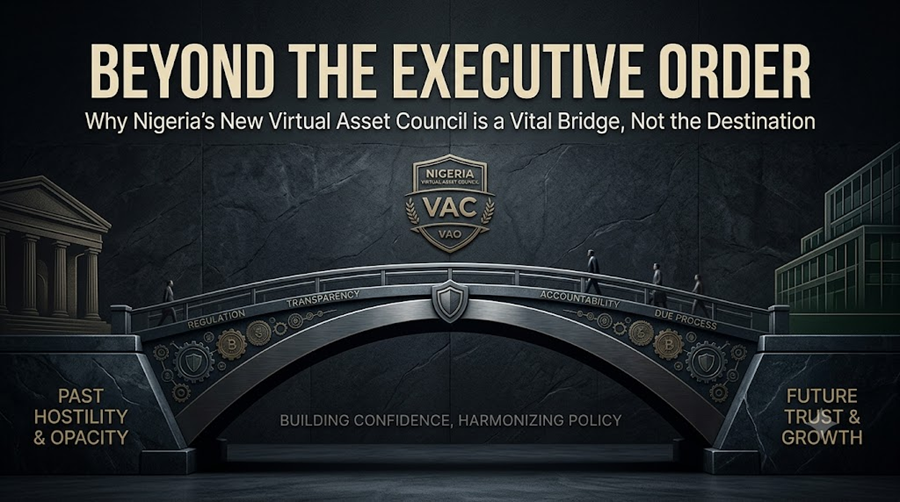
President Bola Ahmed Tinubu’s signing of the Presidential Executive Order on Virtual Assets Coordination, 2026 is a significant milestone. For years, the digital asset ecosystem in Nigeria has been an economic engine running on a bumpy, unpaved road. By explicitly aiming to harmonize regulation, break down agency silos, and foster responsible innovation, this Executive Order provides an immediate administrative framework for a sector that has long survived despite regulatory whiplash.
This step validates what many of us in the legal, policy, and advocacy space have consistently urged: Nigeria needs coordination, not clampdowns; supervision, not suppression.
However, while we welcome this Executive Order as a timely and pragmatic bridge to close dangerous regulatory gaps, we must be clear-eyed about its limitations. An Executive Order is an administrative fix, not a permanent foundation—much less an administrative fix six months to the general elections in Nigeria. To secure true global investor confidence, protect consumers sustainably, and build a resilient digital economy, Nigeria must transition this temporary framework into a comprehensive, overarching Virtual Assets Statute enacted by the National Assembly.
It is however gratifying to see this Executive Order-activated coordination model manifest because it is a strategy the industry itself had recently recommended to this administration. The Virtual Asset Service Providers Association (VASPA), in its forward-looking Project Green-White-Green Whitepaper and its strategic review of the exposed VARA Framework Whitepaper, explicitly recommended an Executive Order as the strategic temporary measure that Nigeria could adopt. VASPA recognized that fixing the immediate lack of regulatory alignment required an agile, decisive executive intervention to align conflicting agencies.
But even then, the ecosystem’s recommendation was this: an Executive Order must only serve as a stop-gap while the country concurrently pursues a comprehensive, statutory virtual asset legislation. By implementing this approach, the Federal Government is smartly adopting a playbook that, at least generally speaking, has industry support.
A Vindication of Years-Long Advocacy: Moving Past the Silo Era
The text of the Executive Order explicitly acknowledges a structural failure that has choked the country’s evolving virtual asset industry: “relevant agencies operating in silos, overlapping in some areas and leaving gaps in others.”
This fragmentation is precisely what I warned against in my past commentary, Nigeria’s Digital Asset Future: Stuck between Regulation and Surveillance, last December. For too long, the ecosystem was caught in a tug-of-war between progressive capital market regulation and highly restrictive security surveillance. Innovation cannot thrive in an environment where an operator is greenlit by one regulator only to be red-flagged by another—both or all in the same government manned by the same presidential leadership in Aso Rock.
By establishing the Virtual Asset Council—uniting the Central Bank of Nigeria (CBN), the Securities and Exchange Commission (SEC), the Nigeria Revenue Service (NRS), the Nigerian Financial Intelligence Unit (NFIU), and the Office of the National Security Adviser (ONSA)—the Federal Government is finally adopting a collaborative stance.
This shift is a welcome departure from the reactive policies of the past. As I noted in Clampdowns, Crackdowns, and Shutdowns in Crypto Town in June 2024, heavy-handed bans do not erase risk; they merely drive it underground, leaving citizens vulnerable and the state blind. Responsible regulation is what Nigeria needs. By choosing supervisory coordination over new bureaucratic layers, President Tinubu’s Order respects existing institutional mandates while forcing agencies to share visibility via a unified regulatory technology platform.
Safeguarding the “Goose That Lays the Golden Egg”
One of the most encouraging components of the Executive Order is the formalization of a regulatory sandbox by the CBN and the impending release of a structured tax policy by the NRS.
Back in 2021, when the regulatory climate was at its most hostile, I wrote a piece titled Analyzing the Use of Cryptocurrencies in Nigeria for Illegal Activities: Before We Kill the Goose that Might Lay the Golden Egg. My argument then remains true today:
“While the risks of money laundering and fraud are real and must be mitigated, freezing out an entire industry because of bad actors is akin to killing the goose that lays the golden egg. The solution is clear risk-based supervision, data sharing, and robust compliance.”
The newly formed Virtual Asset Council directly and effectively applies this logic. Instead of treating Web3 and digital assets as an inherent threat to monetary sovereignty, the framework introduces a controlled sandbox environment. This allows the state to measure risk, evaluate consumer protection, and secure tax compliance empirically before solutions hit the mass market. It moves Nigeria from a defensive position to a strategic position in the global digital economy.
Why an Executive Order is Not Enough
The Executive Order is a masterclass in administrative coordination. I have commended President Donald Trump in the recent past for similar moves in the United States’ FinTech industry, and recommended it to governments in Africa who must take action.
However, we must not mistake the sturdy bridge that an Executive Order provides for the solid ground that an Act of Parliament establishes.
The Executive Order is an exercise of presidential power under Section 5 of the 1999 Constitution. By its very nature, its durability is tied to the executive tenure. It can be amended, revoked, or ignored by subsequent administrations with the stroke of a pen. This inherent transience creates a considerable limitation for the level of institutional capital willing to enter Nigeria.
International venture funds, custody providers, and institutional market makers do not build decade-long business models on the back of an Executive Order. They build them on the rock-solid foundation of an Act of Parliament.
The Case for an Overarching Virtual Asset Act
To transform this temporary alignment into permanent economic infrastructure, the National Assembly must pick up the baton. The 30-day Harmonised Implementation Framework and the forthcoming Virtual Assets White Paper promised by the Presidency should serve as the blueprint for an overarching virtual asset statute.
A dedicated statute will provide three things an Executive Order cannot:
- Absolute Legal Certainty: It clearly defines virtual assets, smart contracts, and decentralized architectures within Nigeria’s statutory jurisprudence, removing any ambiguity for local and foreign courts.
- Permanent Jurisdictional Boundaries: While the EO smoothly negotiates boundaries between the SEC and the CBN for now, a legislative Act permanently codifies these roles, preventing future inter-agency turf wars when leadership changes.
- Enhanced Investor and Consumer Protections: A statute can institutionalize robust, statutory frameworks for digital asset insurance, consumer compensation schemes, and explicit criminal penalties for bad actors, elevating Nigeria’s status globally.
The VASP Bill 2026 and the Power of Stakeholder Engagement
I am delighted to acknowledge that the permanent foundation the ecosystem has been clamoring for is already in motion.
The Virtual Asset Service Providers Bill 2026 recently scaled its Second Reading in the Nigerian Senate. This is a significant legislative step.
Primarily a Bill for an Act to provide a legal and regulatory framework for the licensing, registration, supervision, and regulation of Virtual Asset, Digital Assets, and Virtual Assets Service Providers in Nigeria toward enhancing coordination among relevant regulatory authorities, this Bill represents the permanent architecture Nigeria desperately needs.
However, for this Bill to successfully transform Nigeria’s virtual asset sector and digital economy, I must point out that one ingredient that all stakeholders must treat as absolutely non-negotiable is this: documented, open, meaningful, sincere, transparent, and widespread stakeholder engagement. The last time I experienced the nearest to this was at the Industry Stakeholder Session hosted by the Ad Hoc Committee on the Economic, Regulatory and Security Implications of Cryptocurrency Adoption and PoS Operations of the House of Representatives in October 2025, ably chaired by Hon. Olufemi Richard Bamishile. Before that Committee, I had the privilege of presenting an expert working paper, titled “The Path to Clarity—Proposing a Unified Virtual Asset Service Act (VASA) for Responsible Innovation and Adoption in Nigeria” to the Ad Hoc Committee. It was not only well-received but highly commended. (VASPA reported it here.)
Therefore, it is a welcome development to see that the Red Chamber is taking the legislative initiative forward eventually. And I believe, for best results, this is the time for all stakeholders to work together. The Presidency has laid down an interim bridge. Simultaneously, the National Assembly has moved the legislative intervention into the light. The private sector must now step up.
Day One Duty: The VAC and VAO Must Break the Cycle of Regulatory Hostility, Opacity, and Distrust
In any process involving the management of public trust, building trust rails is critical.
The incoming Virtual Asset Council (VAC) and Virtual Asset Office (VAO) must approach their executive mandates with the utmost professionalism, maturity, and restraint.
To achieve this in an industry that has historically faced systemic hostility, discrimination, and even criminalization, the VAC and VAO must be highly intentional about rebuilding trust. For years, the sector has been stifled by misconceptions within regulatory and law enforcement corridors. Overnight bans, heavy-handed circulars, and a culture of opacity became the default language used to “nurture” this nascent industry.
The VAC and VAO cannot afford to repeat these mistakes or patterns.
If the goal of the Presidency is to foster trust and confidence in a long-suffering virtual asset sector, the Council and Office must anchor their operations on transparency, accountability, and due process aligned with global best practices. They must serve the public and the industry in Nigeria’s best interest, not their own. Given that the VAC and VAO include Nigeria’s highest tax authority, establishing this credibility from Day One is an absolute necessity that cannot be taken for granted.
Crucially, now that these bodies have been activated by an Executive Order, the Minister of Finance must manifestly own and drive the President’s harmonization agenda. Historically, a lack of cohesive political drive from the top has fractured policy direction and executive coordination. This missing link needs to change under the new Finance Minister, Taiwo Oyedele, whose deep professional background is well-suited to bring disciplined, structured reforms to the public sector and finally align executive coordination in the virtual asset space.
Through my work in the industry, especially in my newest capacity as the Chair of the newly created Ecosystem Growth & Advocacy Committee of VASPA, I will continue to explore opportunities for genuine, meaningful, and productive engagements toward rebuilding trust, and moving to next steps.
Next Steps for the Ecosystem
On the executive front, the private sector now has a duty to actively engage with the Virtual Asset Office as its secretariat takes shape at the CBN. To all the actors involved, the upcoming 30-day implementation framework must be practical, non-prohibitive, and globally competitive. And as we welcome the Executive Order as a strategic and necessary first step that breaks the silos, we must remain relentless in advocating for the ultimate goal—a comprehensive legislative framework that permanently secures Nigeria’s digital asset future.
On the legislative front, both the Red Chamber and Green Chamber must ensure that it secures industry-wide buy-in. Here, the Senate with the relevant committee frameworks and the House of Representatives should collaborate. By its nature as the “People’s Parliament,” it is vital that the National Assembly opens the floor to local founders, global representatives, tech law practitioners, compliance experts, local founders, industry bodies, and other stakeholders.
The need for engagement cannot be over-emphasized.
If the law is drafted in a vacuum without the input of those building and using the rails, we risk creating a rigid, unworkable statute that stifles the very innovation it aims to regulate. Early alignment ensures that the resulting Act is both robust enough to protect the financial system and flexible enough to foster market growth. As I illustrated in one of my recent blogs, Cooking Co-Created Crypto Policies: Lessons from Hilda Baci’s Pot of Jollof, nothing beats co-creation. Co-creation in policymaking is the open secret and best cheat for proactively achieving sound legitimacy and solid compliance in one swoop of Hilda Bassey’s giant spoon! When eventually served, everyone wants to be onshore where the dining table is, not off-shore.
Copyright © 2025 Senator Ihenyen. All rights reserved. Designed by Beacon Lanbs & Tech Solutions