
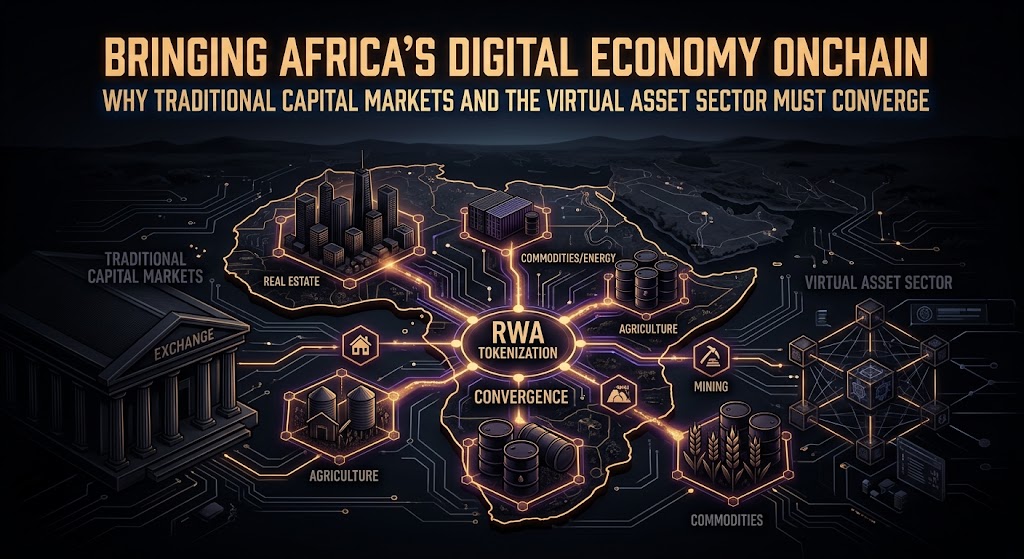
For nearly a decade, the narrative surrounding virtual assets in Africa was largely defined by retail survival and currency hedging. Young, tech-savvy demographics turned to decentralized rails to bypass payment friction, protect purchasing power against double-digit currency debasement, and participate in a borderless gig economy. It was an era dominated by peer-to-peer volume, speculative trading, and a palpable sense of mutual suspicion between innovators and regulatory authorities.
On Wednesday, 30 September 2026, at the Tokenized Economy: Bringing Africa’s Digital Economy Onchain summit in Abua, the paradigm shift—where the traditional capital markets and the virtual asset sector are beginning to converge was apparent.
Convened by Jude Ozinegbe and the Cyberchain team in partnership with the Securities and Exchange Commission (SEC Nigeria) and the Nigerian Capital Market Institute (NCMI), the gathering signaled an undeniable turning point: Africa’s digital asset conversation has graduated from speculative trading to institutional market infrastructure.
Representing the Virtual Asset Service Providers Association (VASPA) at the annual event, I observed firsthand that the real frontier of financial innovation is now about building the bridges that bring traditional capital markets onchain, no longer about isolated blockchain experiments.
The False Dichotomy: TradFi vs. Web3
For too long, industry discourse has been trapped in a false dichotomy. Enthusiasts claimed blockchain would render traditional finance obsolete, while legacy institutions dismissed the entire asset class as an unregulated casino. Both views missed the larger structural reality.
Traditional capital markets and the emerging virtual asset sector do not represent mutually exclusive ideologies. These two sectors represent two halves of a single, evolving financial architecture.
The traditional capital market possesses what decentralized systems cannot invent overnight: decades of regulatory jurisprudence, investor protection frameworks, institutional capital depth, and the bedrock of public trust. But our legacy markets continue to wrestle with systemic friction—illiquid asset classes, cumbersome settlement cycles, prohibitive intermediary costs, and high minimum entry thresholds that effectively shut out the vast majority of retail investors.
Conversely, the virtual asset ecosystem brings what legacy markets urgently need: 24/7 programmatic settlement, cryptographic provenance, fractionalization capabilities, and frictionless global liquidity rails.
To achieve maximum economic value, these two spheres must integrate. The blockchain is not arriving to displace the capital market; it is arriving to dematerialize, modernize, and scale it. That’s what emerging technologies, including AI, do. They reimagine models for digital transformation.
Unlocking Trapped Value Through Real-World Asset (RWA) Tokenization
The most compelling thesis discussed in Abuja was the tokenization of Real-World Assets (RWAs).
Across Africa, trillions of dollars in real economic value remain trapped in illiquidity. Vast tracts of commercial real estate, strategic agricultural commodities, mineral reserves, infrastructure debt, and private equity are locked behind institutional blocks and inefficient paper-based registries. And when you have a situation where assets cannot be easily traded, divided, or verified, capital formation slows significantly.
Tokenization fundamentally transforms this equation. By representing sovereign or private assets as cryptographic tokens on compliant distributed ledgers:
- Illiquid markets become fluid: Real estate developments or agricultural yields can be fractionalized into affordable digital units, unlocking access for everyday retail investors while generating domestic liquidity for project developers.
- Settlement risk collapses: The gap between trade execution and clearing shrinks from days (T+2 or T+3) to atomic, automated execution via smart contracts, drastically cutting counterparty and systemic risk.
- Cross-border capital flows seamlessly: A compliant virtual asset framework allows diaspora capital and foreign portfolio investors to allocate funds directly into African infrastructure or commodity projects with auditable, onchain transparency.
During the exhibition where I engaged some of the participants at the VASPA booth, my engagement with institutions like the Lagos Commodities and Futures Exchange (LCFE) made one thing abundantly clear: traditional market operators already recognize this synergy. They understand that bringing commodities and structured instruments onchain is the fastest route to deepening market participation and unlocking domestic capital.
But we must also be careful about projecting tokenization like some magic wand that automatically creates intrinsic value for any asset once deployed. Fundamentally, a “digital wrapper” or “secured vehicle” does not make a worthless asset valuable. In other words, if worthless “assets” are wrapped or secured, this does not create intrinsic value. And this is why the real value cannot be the blockchain, but the product the technology enhances.
Regulatory Co-Creation: The Paradigm Shift from Regulatory Monarchy
A few years ago, a gathering of this caliber would have been unthinkable. The decisive factor behind the success of the Tokenized Economy summit was its institutional anchor: the active co-partnership of SEC Nigeria and the NCMI alongside Cyberchain.
Jude Ozinegbe deserves immense commendation for his visionary persistence. Convening the ecosystem is hard; convening it with the apex capital market regulator and its primary educational institute is symbolic.
With a statutory regulator stepping out from behind administrative desks to co-host an industry dialogue on tokenization, it sends a clear signal across the continent: Nigeria is moving decisively from prohibition to regulation. Hopefully, with time, more of our regulators will fully embrace the idea of moving from regulatory monarchy to regulatory co-creation.
And speaking of paradigm shifts, I absolutely agree with the central message of the Chief Operating Officer (COO), Emerging Technologies and Innovations, Nigerian Financial Intelligence Unit (NFIU) and Member Egmont Secure Web (ESW) Advisory Board, Egmont Group of Financial Intelligence Units (FIUs), that regulators must move beyond simply following transactions. He emphasized that to build trust in the digital economy, we must shift from simply tracing transactions to understanding identity, assets, ownership, assets, transactions, and networks in the financial system, and we must also embrace public-private partnerships (PPP).
The Frontline Responsibility: Why SROs Matter
As we stand on the threshold of this onchain economy, the role of self-regulation becomes paramount. Statutory regulators like the SEC cannot—and should not—be expected to police every technological nuance or smart contract deployment in isolation.
This is precisely why Self-Regulatory Organizations (SROs) exist. If we really want traditional capital markets to trust virtual asset rails, industry operators must hold themselves to the highest standards of governance. And this means enforcing strict client asset segregation, establishing enterprise-grade cybersecurity resilience, operationalizing FATF Travel Rule compliance, and eliminating fraudulent token offerings through rigorous disclosure standards.
By establishing our newly announced Institutional Tier and launching working groups on financial intelligence sharing and passporting, VASPA is preparing the ecosystem for seamless integration with legacy finance. Onchain transition requires professional discipline.
Building the Rails for Africa’s Century
Clearly, the bridge between traditional finance and the decentralized economy is under construction.
Just as Africa did with mobile telecommunications and mobile money, the continent has a golden opportunity to transform legacy infrastructure by leveraging the governance maturity of our capital markets with the dynamism of distributed ledger technology. This is because in a world transitioning toward multipolar trade, programmable sovereign currencies, and digital settlement systems, we cannot afford to operate on fragmented, manual financial rails.
We cannot also afford to have yet another conversation end as mere conference talking points. They must materialize into inter-market trading linkages, time-lined regulatory sandbox cohorts for tokenized instruments, and enduring public-private partnerships. From operators to regulators; innovators to investors, we must build the rails for Africa’s century.
Copyright © 2025 Senator Ihenyen. All rights reserved. Designed by Beacon Lanbs & Tech Solutions